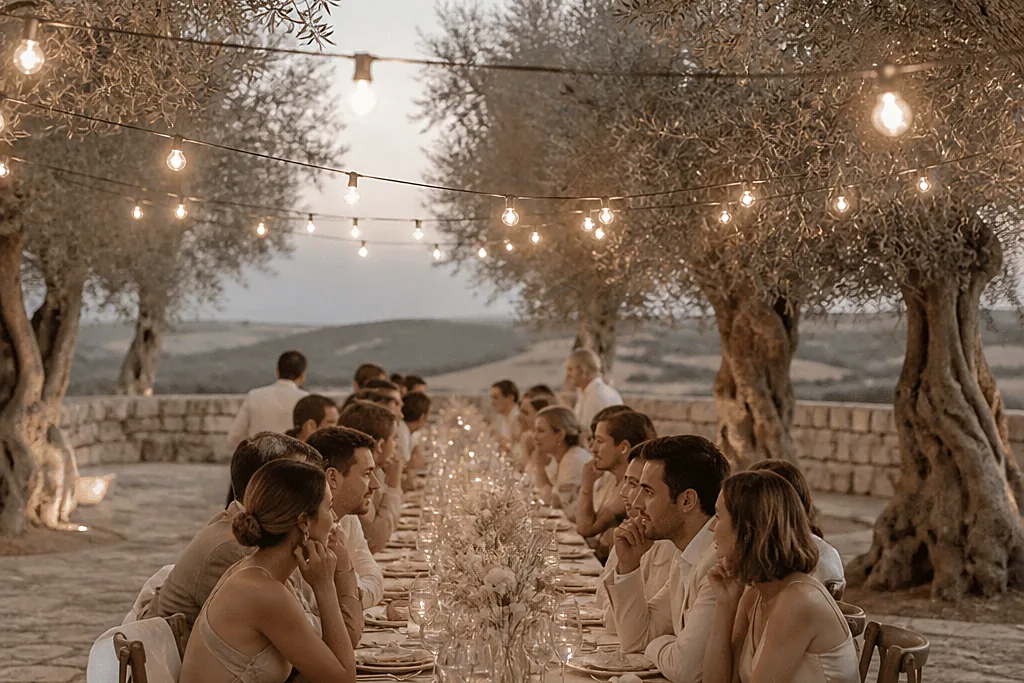
Rosa and Emil did not have a wedding day. They had a wedding weekend, in a farmhouse an hour inland from the coast, with thirty-eight people who all slept under the same roof and ate at the same table three days running.
I photographed all of it, and I have thought about that decision ever since. Not the celebration itself — that was always going to be lovely. The structure of it.
Friday
People arrived through the afternoon in ones and twos, with the particular awkwardness of guests who do not yet know each other. By eight there was a long table on the terrace and somebody’s aunt was carrying out bowls, and by eleven the awkwardness had gone entirely.
That evening is the reason the whole weekend worked. On a normal wedding day, the ceremony is the first time most guests are in a room together, and everyone is still finding their feet by the time the speeches start. Here, they had already had a night of it.
By Saturday morning nobody was a guest any more. They were just people who had already had dinner together.
Saturday
The ceremony was at six, deliberately late, in the grove itself. Thirty-eight chairs on dry earth under trees that were old when the farmhouse was built. It lasted eleven minutes.
What I remember is how quiet it was. No sound system, no aisle runner, no processional music — just a lot of people being extremely still while two of them talked. You can hear that quality in the photographs, which is a strange thing to say about photographs, but you can.
Six in the evening, forty degrees in the shade, and nobody in any hurry at all.
Sunday
Breakfast for whoever was awake, which by half past nine was everybody. Rosa in a t-shirt and yesterday’s earrings. Emil making coffee badly for twelve people. Somebody’s children in the fountain.
These are the frames they printed. Not all of them — the ceremony is in the album, and the long table under the lights is the photograph above their stairs. But the morning-after breakfast takes up eight spreads out of fifty, and when I asked why, Rosa said it was the only part where everybody looked like themselves.
Would I recommend it
Honestly: only if the shape genuinely suits you. A weekend is not simply a longer wedding, and it does not solve anything that a single day gets wrong.
It works when your people are travelling anyway, when there is one building that holds everybody, and when you actively want the informal parts — the arrival, the breakfast, the swim — to matter as much as the ceremony. If those three things are true, it is the best version of a wedding I know.
It does not work when it is really a one-day wedding with extra events bolted on either side to justify the venue hire. Guests can feel the difference immediately, and so can a camera.
One practical note
If you are doing this, protect one afternoon with nothing in it. Rosa and Emil left Saturday from noon to four completely blank, and it is the only reason anyone had the energy for the evening. Every weekend wedding I have photographed that skipped this ran out of steam by the second night.
— Amanda