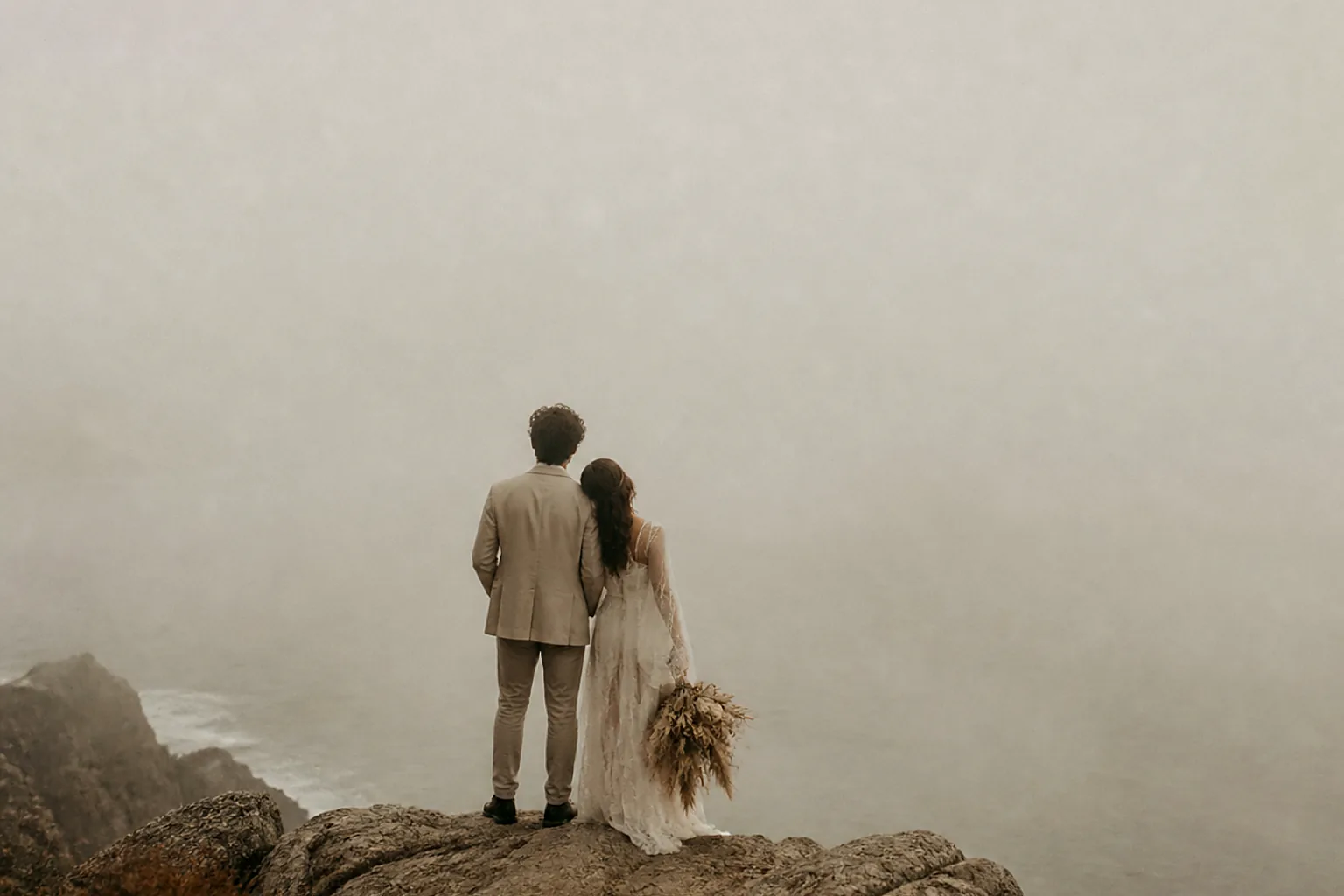
The forecast had been the same for six days: fog, thickening after dawn, visibility under fifty metres. Nell sent me a screenshot of it at eleven o’clock the night before with a single line underneath. Do we move?
We did not move.
They had chosen the headland because Arthur’s grandfather had proposed there in 1961, in weather that family legend insists was considerably worse. Postponing to chase a clear sky would have meant giving up the only thing about the location that actually mattered.
What fog does to a photograph
Everything I know about light says that fog is a gift and everything a couple has ever seen on Pinterest says it is a disaster. Both cannot be true, and it is not the couple who is right.
Fog removes the background. It removes the horizon, the far cliffs, the distracting white house half a mile away, the fence, the other walkers. What remains in the frame is two people and a soft grey nothing, which is an extraordinarily generous thing to hand a photographer.
Bad weather does not ruin photographs. It simplifies them, which is nearly always an improvement.
It also does something to sound. We walked out at half past seven and the whole world was muffled — no gulls, no wind noise, just boots on wet grass and the two of them talking quietly about whether the path was the right one. I hung back thirty metres and let it happen.
The vows took four minutes. Arthur got through his; Nell did not get through hers.
The whole day, in order
- 06:40 — coffee in the cottage kitchen, both still in coats, neither of them eating anything.
- 07:30 — the walk out. Twenty-five minutes, uphill, in near-total whiteness.
- 08:05 — the ceremony. Two witnesses, a registrar who had walked up in wellingtons, and no music because there was no way to carry a speaker.
- 08:20 — forty minutes of simply being up there, mostly not photographed.
- 10:00 — breakfast in a pub that had opened early as a favour. Nell wore her dress. Nobody in the pub commented, which was somehow perfect.
- 15:00 — a second walk, lower down, when the fog finally started to lift.
Six hours of coverage, forty of them genuinely photographed. The rest I spent standing slightly apart with a cold camera, waiting.
If you are planning something like this
Three pieces of advice, learned mostly by getting them wrong before.
Book the weather, not the view. Choose a place that means something regardless of visibility. If your location only works in sunshine, you have not chosen a location, you have chosen a photograph.
Give yourself the whole day anyway. Elopements are short. That is the appeal. But leave the afternoon open, because conditions change and the second walk is often better than the first.
Bring the boots. Nell wore walking boots under her dress for the entire ceremony and only changed for the photographs she asked for specifically. It is in perhaps six frames and she loves every one of them.
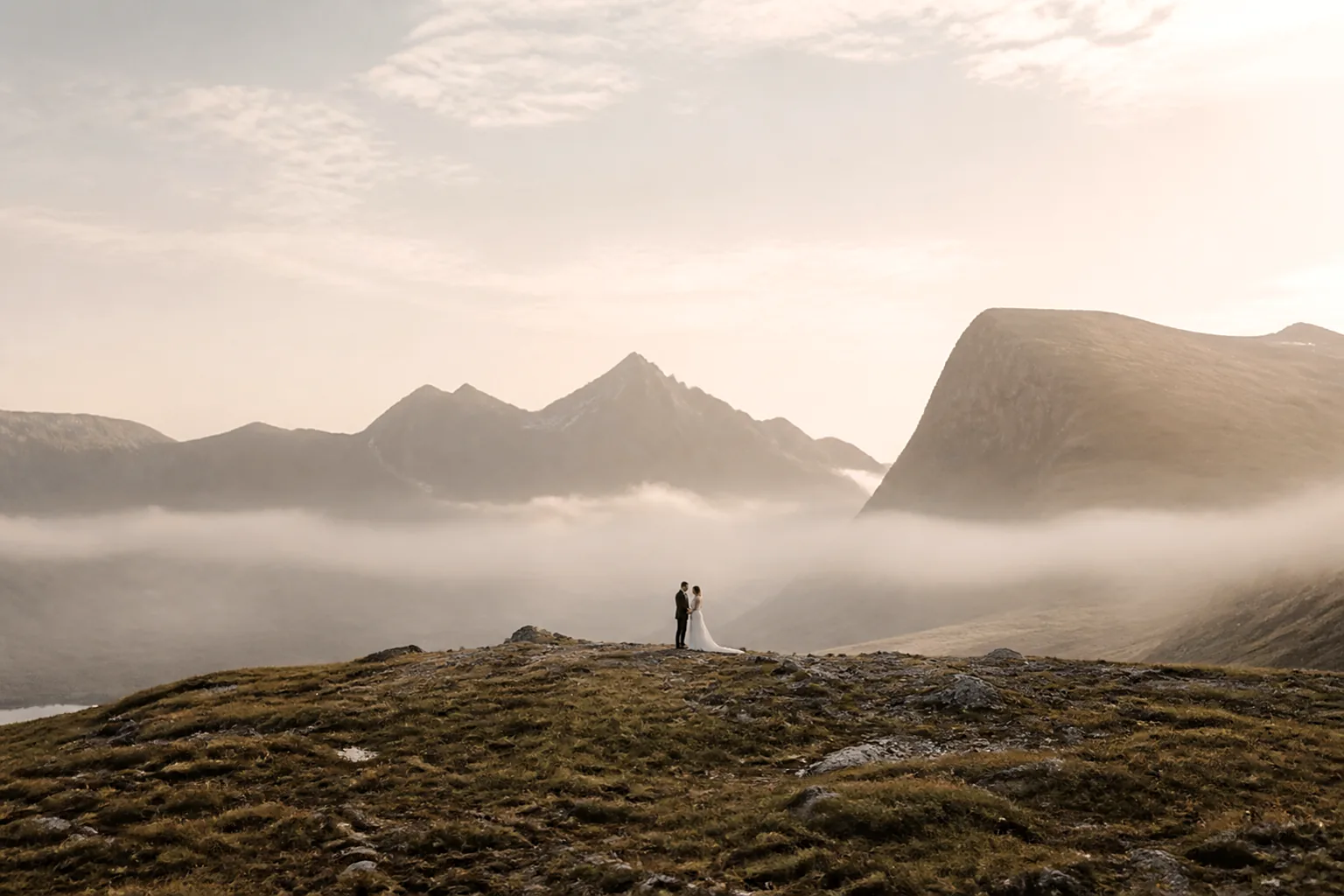
By three o’clock the valley behind the headland had opened up completely.
What they said afterwards
“It rained sideways for four hours and it was the best day of our lives,” Nell wrote, some weeks later, when the prints arrived. “You never once suggested we wait it out.”
I never would. The weather your day happens in is part of the day, in the same way the people and the place are. Photograph it honestly and in ten years it will be the first thing you tell anybody about.
— Amanda